3 Power-user features in Vent.X

We strive to ensure that HVAC designers find suitable and reliable ventilation solutions for their projects with our tools. Below we introducethree functions that anyone can use to take air terminal device design to a new level on Vent.X.

1. Structural beams

The beams affect the throw patterns of the air terminal devices. Especially in renovation projects, the location of the terminals cannot always be influenced. Considering the effects of the structures is really important in order to avoid the feeling of draught. By designing throw patterns while taking into consideration the obstacles in the room, one can effortlessly determine whether the correct terminal has been selected for the space and whether its location is suitable.
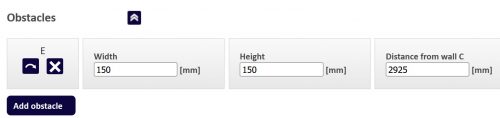
 

In throw pattern modeling view, Vent.X has an “Obstacles” section. “Add Obstacle” button creates a bar. The width, height, and position of the bar can then be changed. If necessary, several bars can be added using the “Add Obstacle” button.

2. Terminal positioning buttons

To speed up the design work, the selection program has buttons for positioning the terminals. The program places the terminals in the room symmetrically in relation to each other and to the space. This gives the designer terminal locations – fast!
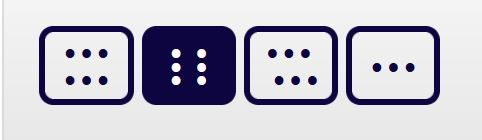
When the room contains more than one device of the same kind, radio buttons appear at the bottom of “Diffuser” tab. You can select different device layouts from the buttons as needed.

3. Optimize air flow

Sometimes dimensioning airflows at desired temperatures and for a specific size of a room can require complex calculations. Airflow optimizing becomes handy when the throw pattern is required to come down to the floor-level or at the edge of the occupied zone.
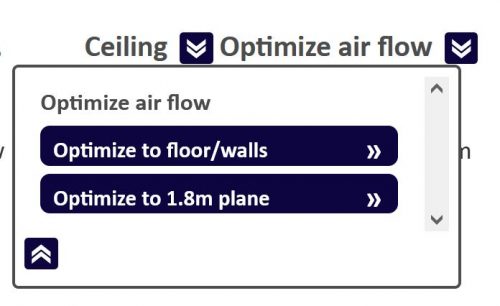
From the top of the simulation screen, the airflow optimization can be selected either to the floor, wall, or 1.8 m level, which marks the occupied zone. Parameters such as room dimensions, supply air and room temperatures, as well as the location of the terminals can be changed. The effects of changes to the throw pattern can be quickly assessed on the program.
Go try Vent.X

News

Get to know: Product Development Engineer Eero Kahilaniemi

This time in our Climecon team spotlight, we’re heading to our factory in Kausala. Eero is originally from near Tampere, about 180 km north-west of the capital city Helsinki, and his studies eventually led him to Kausala. Trained as an engineer in wood technology, Eero made the transition from wood to steel when he joined Climecon as a test engineer. Today, he works as a product development engineer, with his role having expanded from testing to product development projects and product design—particularly in the area of air terminal devices.

Read more

Top-quality indoor climate through smart choices – insights from Engineering Company Lappialämpö

According to Tero Lehtola, CEO of Lappialämpö, the indoor climate quality can be influenced surprisingly much even by the choice of diffusers. In Lappialämpö’s projects, the combination of HRV units, duct coils, and our RINO and LINE diffusers forms an effective system that ensures an even, draft-free indoor climate—just as it should be in comfortable, functional spaces. Lappialämpö Oy is a reliable full-service building services engineering company in the Lapland region, with a particular strength in high-quality, comprehensive HVAC design.

Read more

Get to know: Sales Manager Veli-Matti Piispanen

A favorite among customers, Veli-Matti knows snow and rain covers, roof hoods, and hoods like the back of his hand. Veli-Matti, or Velsu as he’s known to friends, has been working at Climecon since 1999. In addition to his sales role, he also helps manage products for snow and rain covers, and roof hoods together with the Product Manager. His enthusiasm for his work is as strong as it was at the start of his career, and as a thrill-seeker, Velsu is always ready for new adventures.

Read more