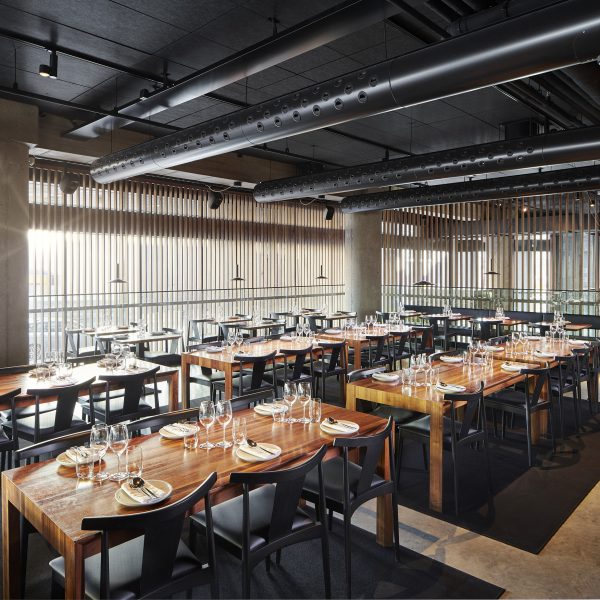
Nozzle ducts are particularly well-suited for spaces with high occupancy and large ventilation demands. Such spaces include schools, daycare centers, offices, and restaurants. In these environments, ventilation systems must provide both sufficient capacity and high indoor air quality. The high induction rate of nozzle ducts enables efficient mixing of supply air with room air, which evens out temperature differences and prevents the feeling of draught even at high airflow rates. This gives designers greater freedom to dimension systems reliably without compromise.
A space-efficient solution that supports architecture
Another significant advantage from a design perspective is the optimization of space usage. With nozzle ducts, suspended ceilings are not required, allowing the full room height to be utilized and creating a more spacious impression. Traditionally, suspended ceilings have been used to conceal ventilation ductwork, but nozzle ducts allow ventilation to become a visible and controlled part of the interior space. This simplifies structures while supporting modern architecture, where building services are integrated naturally into the design.
Clear implementation and controlled performance
From an implementation standpoint, nozzle ducts also stand out due to the clarity of the system. When air distribution, balancing, and sound attenuation are integrated into a single solution, the number of required components decreases. This results in smoother installation and a result that more accurately matches the intended performance values. The role of balancing and attenuation components is especially important, as they ensure that airflow rates, pressures, and noise levels remain under control in all operating conditions.
Easy maintenance and flexibility for changing spaces
From the perspective of operation and maintenance, nozzle ducts also offer clear advantages. Their smooth surface is easy to keep clean, and separate access hatches are generally unnecessary. In addition, preset adjustability speeds up commissioning and reduces the amount of on-site balancing work, making life easier for both contractors and designers.
The adjustable and precisely directed air distribution pattern of nozzle ducts also increases flexibility when spaces are modified. For example, in learning environments, room functions may change frequently, requiring ventilation systems to adapt to new conditions without extensive renovation work. For this reason, nozzle ducts are an especially practical and long-lasting solution for classroom ventilation.